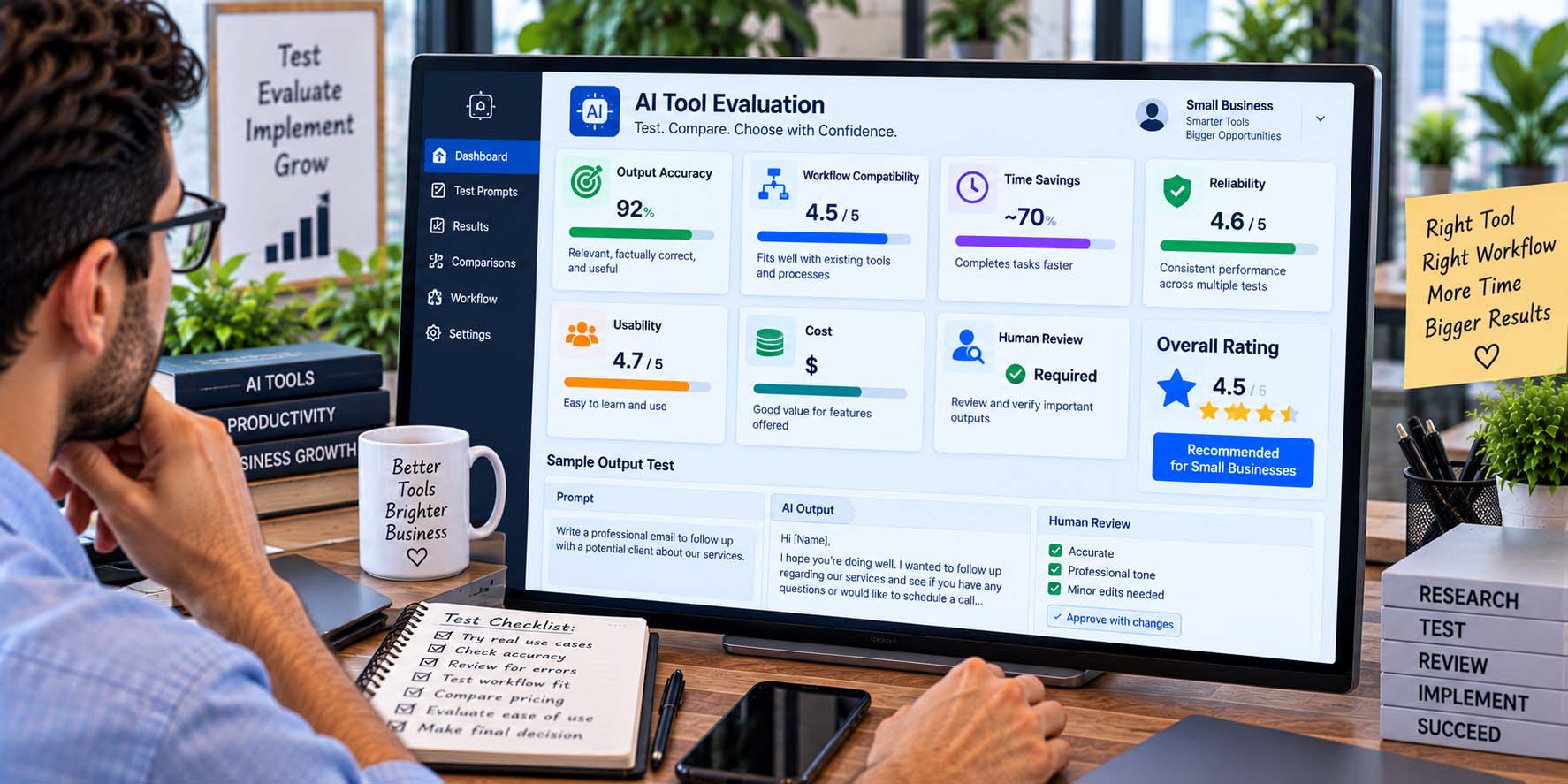
To evaluate AI tools for business, focus on whether the tool solves a real workflow problem, produces reliable enough outputs, saves meaningful time, fits existing processes, and costs less than the value it creates. An impressive demonstration alone does not make an AI tool useful for everyday business operations.
A practical evaluation should begin with a specific task. Instead of asking whether an AI platform is generally powerful, determine whether it improves a process your business actually performs.
Start With the Business Problem
Before testing features, define what you want the AI tool to improve.
A business might want to reduce the time spent drafting routine emails, summarize lengthy documents, organize customer feedback, prepare initial content drafts, classify information, or support administrative work.
The problem should be specific enough to measure.
For example, “use more AI” is not a practical objective. “Reduce the manual work required to turn meeting notes into action items” is much clearer.
Once the purpose is defined, unnecessary features become less important. The question becomes whether the tool improves that particular workflow.
Evaluate AI Tools for Business With Real Tasks
A controlled demonstration may show what a product can do, but everyday business information is often less organized.
Therefore, test the AI with realistic tasks similar to the work employees actually perform.
If the tool will summarize documents, try several representative documents. If it will assist with customer communication, evaluate typical communication scenarios.
A tool that performs well only with carefully prepared examples may require too much effort in normal use.
Realistic testing provides a better picture of practical value.
Check the Quality of the Output
Speed has limited value if employees must spend substantial time correcting the results.
Review whether outputs are:
- Relevant to the request
- Factually dependable where verification is possible
- Complete enough for the intended task
- Consistent across similar requests
- Written or structured in a usable format
- Easy for an employee to review
Different tasks require different quality standards.
A brainstorming tool can still be useful when some suggestions are weak because employees can quickly select the useful ideas. An AI system assisting with consequential business information requires much stronger verification.
The required level of accuracy should match the importance of the task.
Measure the Entire Workflow, Not Generation Speed
An AI system may produce an answer in seconds while still making the overall process slower.
Consider everything employees must do before and after using it.
They may need to prepare information, remove sensitive details, write detailed instructions, correct the output, copy information between applications, reformat results, and perform final checks.
All of these steps are part of the workflow.
Businesses exploring practical guidance on technology, AI, operations, finance, and other management topics can look at this site from GrowBizLab as part of their broader research.
When evaluating an AI tool itself, compare the complete AI-assisted process with the existing process rather than focusing only on how quickly the system generates a response.
Check Whether It Fits Existing Workflows
A useful AI tool should fit reasonably well into how the team already works.
Consider whether employees must constantly switch between applications, manually transfer information, learn complicated procedures, or maintain another separate system.
A tool does not necessarily need deep integrations to be useful. For a simple task, a standalone AI application may be enough.
However, if the intended workflow depends heavily on documents, email, customer records, or project data stored elsewhere, poor compatibility can create additional manual work.
Workflow fit can therefore matter as much as the AI model’s capabilities.
Consider Reliability Over Repeated Use
A useful business tool should not work well only once.
Test similar tasks multiple times and look at the consistency of the results.
Does the tool follow the requested format? Does it regularly omit important information? Does output quality vary significantly even when the input is similar?
AI systems naturally produce variable outputs in many situations. The important question is whether that variability remains manageable for the intended workflow.
If employees constantly need to repair the same type of problem, the tool may not be suitable for that task without a better process around it.
Calculate the Real Cost
Subscription price is only one part of the cost of adopting AI.
A business should also consider employee training, setup time, integrations, administrative work, output review, and the possibility of paying for overlapping software.
A relatively inexpensive AI tool may still offer poor value if employees rarely use it.
Conversely, a higher-priced platform may be reasonable when it consistently reduces substantial manual work or replaces another paid service.
The relevant comparison is cost against practical business value, not price alone.
Review Privacy and Security Requirements
An AI platform may perform a task well but still be unsuitable for the information involved.
Before using sensitive customer, employee, financial, contractual, or proprietary data, businesses should examine the provider’s applicable privacy documentation, security controls, permissions, retention practices, and account options.
The business should also consider what information employees actually need to provide.
If a task can be completed without names, confidential figures, credentials, or other sensitive details, removing unnecessary information can simplify the risk-management process.
Privacy and security requirements should be part of the evaluation rather than an afterthought.
Consider How Much Human Review Is Needed
Human review is another factor in determining practical usefulness.
Some AI outputs are quick to inspect. Others require detailed verification.
If an AI system saves five minutes of drafting but creates ten minutes of fact-checking and correction, the workflow has not become more efficient.
The appropriate review level depends on the task. Internal brainstorming may require little checking, while customer-facing, financial, contractual, personnel, or other consequential material may need significantly closer oversight.
The amount of review should be included when assessing the tool’s real efficiency.
Test Before Expanding Access
A limited trial can reveal problems before an AI tool becomes part of a wider business process.
Select one or two realistic use cases and allow a small number of employees to test them consistently.
Observe what works, what needs correction, where employees become confused, and whether the process actually becomes easier.
If the results are useful, the business can expand the tool gradually. If not, it can adjust the workflow or stop using the product without having invested heavily in a broader rollout.
Useful AI Should Make Work Easier
The value of an AI platform is not determined by how many features it offers or how advanced its technology appears.
A useful tool should improve a defined business task without introducing more work than it removes.
To evaluate AI tools for business effectively, test them with realistic work, examine output quality, measure the complete workflow, consider reliability and cost, review privacy requirements, and account for human oversight.
If a tool consistently makes an important process faster, clearer, or easier to manage while maintaining acceptable quality, it has a practical role. If it mainly adds subscriptions, corrections, complexity, or extra steps, the business has a strong reason to reconsider whether that AI tool belongs in its workflow.